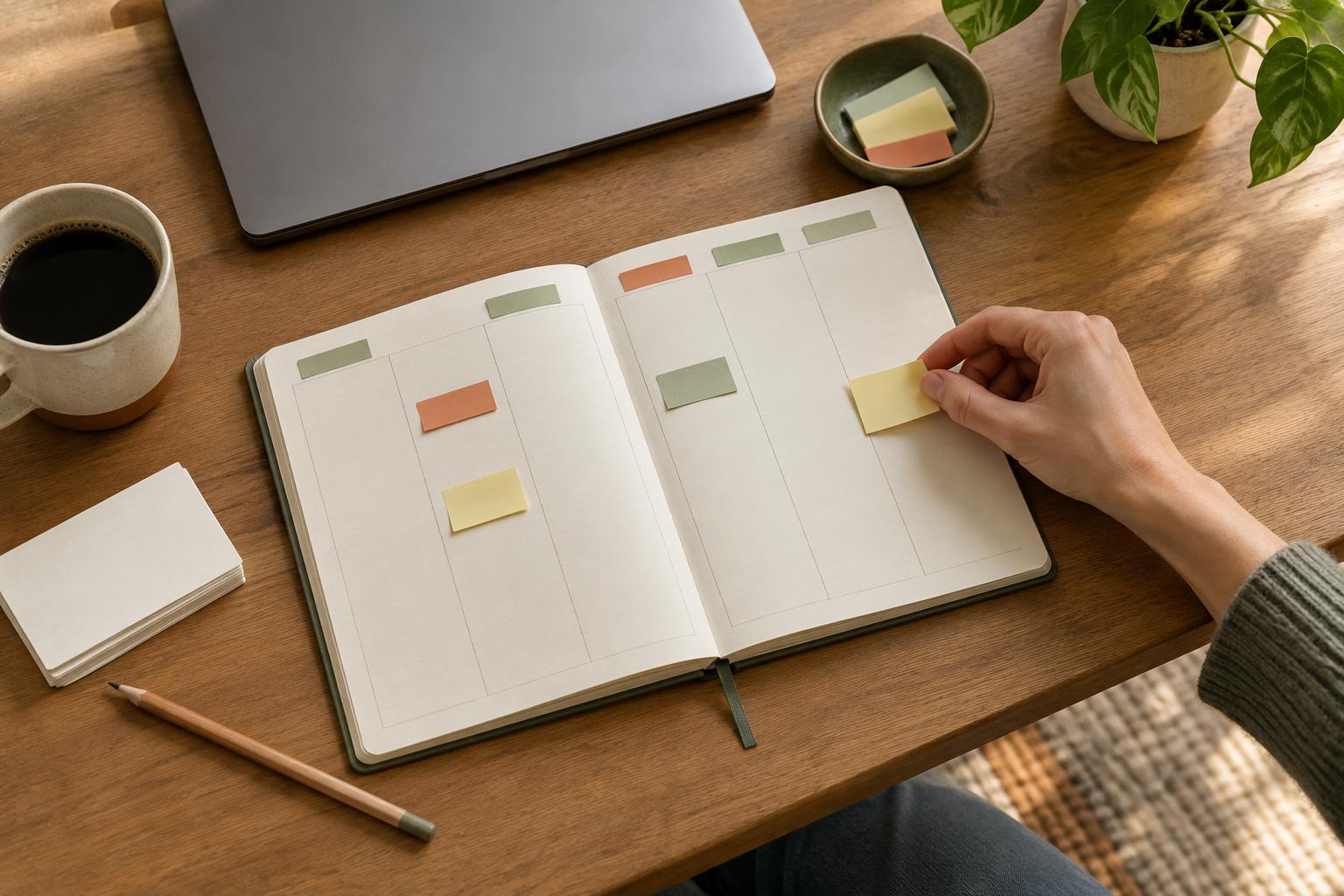
Put every commitment in one place
Creative work is difficult to prioritize when its pieces live in different places: a client email, a sketchbook, a task app, and an idea you keep meaning to start. Begin with one list of active projects and proposed projects. Include client deliverables, portfolio updates, experiments, and administrative work that supports them. For each item, write down the next concrete outcome rather than a broad label. “Send three homepage concepts” is easier to compare with other work than “website redesign.”
Separate commitments from possibilities. A promised delivery has a different weight from an idea with no audience or agreed date. That does not mean personal work always comes last; it means you can see which deadlines involve other people before deciding how much space to protect for your own projects. If a project is too large to judge as one item, break it into milestones you could reasonably complete or review.
Judge the deadline, not just the date
A deadline matters most when missing it has a clear consequence. Mark whether the date is agreed with a client, needed by a collaborator, tied to another task, or simply a target you chose. Then note how much usable time remains. A project due later may need attention now if it requires feedback, revisions, or materials from someone else. Conversely, a self-imposed date may be movable without harming the project.
Look for the earliest point at which your work becomes a bottleneck. If a collaborator cannot begin until you send a draft, sending that draft may be more urgent than polishing a deliverable with the same final due date. When two firm commitments cannot both fit, prioritizing is not enough: clarify scope, request a revised timeline, or arrange support before the conflict becomes a last-minute surprise.
Define impact for the work you actually want
Impact is not the same as visibility. For a freelancer, a quiet revision that fulfills a client promise may have more immediate value than a public-facing side project. For a creator building a portfolio, a focused case study might serve a longer-term goal better than several small posts. Ask what each project will change: Will it meet a commitment, improve a useful skill, create a strong example of your work, or remove an obstacle from future projects?
Give each project a short impact note instead of relying on a vague “high” or “low” rating. For example, “allows the developer to start” identifies a specific benefit; “might be good exposure” leaves more uncertainty. You can still choose speculative work, especially when experimenting is part of your practice. Just make that choice deliberately, without treating a possible payoff as a guaranteed one.
Estimate effort and find the smallest useful step
Effort includes more than hours spent making. Consider preparation, decisions, feedback, revisions, and the energy a task requires. A short presentation may take longer than a larger production task if its direction is unresolved. Use rough ranges rather than precise predictions, and flag work with many unknowns. If you cannot estimate a project yet, its next step may be a brief discovery session to identify what needs to be done.
High-impact, low-effort tasks are often good candidates for an early work block, particularly when they unblock someone else. High-impact, high-effort projects need reserved time rather than repeated postponement. Low-impact, high-effort ideas may be worth reducing in scope, pausing, or declining. Treat these as prompts for judgment, not rigid rules: a demanding personal experiment can still deserve time if it supports a goal you have chosen.
Choose a short queue and review it regularly
Once you have considered deadline, impact, and effort, select a small queue: what needs action now, what is next, and what can wait. Put firm, consequential deadlines where they belong, then reserve a realistic block for important work that has no external due date. Write the next action for each active project so that starting does not require another round of planning. Keep the waiting list visible, but do not treat every idea on it as an active obligation.
Review the queue when new work arrives, feedback changes a deliverable, or an estimate proves wrong. A brief recurring check also helps prevent flexible projects from disappearing indefinitely. If a personal project keeps losing its place, give it a smaller milestone or a protected session rather than an ambitious deadline you will repeatedly move. A useful priority system is not a permanent ranking of your ideas; it is a way to make honest choices with the time and information you have.